Motivational Interviewing: A Powerful Tool for Dietitians and Health Coaches
Jun 04, 2024
What is Motivational Interviewing?
Motivational Interviewing (MI) is a client-centered communication method used to guide behavior change by helping clients explore feelings of uncertainty so they can work through their ambivalence, increase their motivation, and lean into taking action towards their goal to change a health behavior.
Key Coaching Terms: AmbivalenceIt’s common for coaching clients to have mixed feelings about changing their behavior. This uncertainty, or ambivalence, can significantly impact your client’s willpower and motivation. Even if the goal they hired you to help them achieve is deeply and personally meaningful to them. That’s just one reason why Motivational Interviewing is such an essential skill for health and wellness professionals to have in their coaching toolbox. |
Motivational interviewing is widely used because with more than 30 years of studied application, it is well-established as an effective method for supporting behavior change. MI is known for being especially effective for initiating lifestyle goals or overcoming habits and behaviors that are hard to change, like addiction, alcohol abuse, unhealthy eating, and not exercising enough. (Or at all.)
Motivational interviewing encourages clients to explore their personal motivations and the individual roadblocks that are slowing–or stalling–their progress.
(👆This is how MI empowers clients to take control of their own personal growth and behavior change process.)
That’s what makes motivational interviewing such a powerful tool for health coaches and dietitians: MI draws clients into genuine dialogue where they feel safe sharing their thoughts and feelings instead of health practitioners simply prescribing a plan of action without client engagement, feedback, or buy-in.
Motivational Interviewing is Not❌ A quick or easy coaching solution. MI is a skill that requires training and practice. ❌ A step-based process or technique. Researchers tried. It didn’t work. ❌ A verb. Motivational Interviewing is something you do with your client. Not to them. ❌ A comprehensive approach. This is not the be-all and end-all of coaching tools. ❌ A trick to deceive or coerce your client. MI empowers client autonomy. |
Before I get deeper into motivational interviewing, it's very important to note that it is not a quick “technique” you learn in one sitting. It's a skill that requires practice over time. You might hire someone to help you and practice with you, you probably should read some books, and you'll stumble and feel awkward for a while. When you’re an experienced coach who is used to feeling confident, it can be uncomfortable. But it’s not you. It’s just part of the learning process.
Start Here.👇 Get Your MI Cheat Sheet.
Old Habits Die Hard
Learning curve aside, motivational interviewing is still especially valuable to health and wellness practitioners because it promotes increased client confidence, autonomy, and capacity. These are deeply valuable skills for anyone, but especially clients facing significant challenges in changing their habits and maintaining a healthy lifestyle.
Motivational Interviewing does more than just teach you how to communicate more effectively with your clients. Motivational interviewing gives you real tools to help your clients navigate the mixed emotions and internal conflict that come up when they start working to change their health habits.
After all, the saying is “old habits die hard” for a reason.
When you can coach your clients through the most vulnerable and persistent obstacles in their health and wellness journey, you set yourself apart in a sea of coaches as The One who gets real, lasting results for your clients.
4 Reasons Motivational Interviewing is a Powerful Tool for Health and Fitness Coaches
- Build trust and rapport with your clients. Motivational interviewing helps clients feel heard, respected, and understood. Which leads your clients to become more engaged, and more open to asking for–and receiving–help.
- Be more effective at empowering clients. Motivational interviewing is a skill that requires training and practice, but it can make you a significantly more effective fitness coach by teaching you to empower your clients to find their own motivation.
- Expand your understanding. Motivational interviewing gives you strategies to navigate challenging conversations so they lead to more powerful and progressive interactions with your clients.
- Increase your impact and profits. As a fitness coach, leveraging motivational interviewing in your practice can make a massive shift in your business when it comes to client retention, adherence, and success.
Get Started for Free: Download Your Motivational Interviewing Cheat Sheet Here👇
Weight Loss, Motivational Interviewing,and Health Behavior ChangeMotivational interviewing to improve weight loss in overweight and/or obese patients: a systematic review and meta-analysis of randomized controlled trials
Results? Motivational interviewing was shown to be an effective strategy for weight management in this population. |
How To: Motivational Interviewing for Health Coaches
Components of Motivational Interviewing
We can break down motivational interviewing into three components: skills, guiding principles, and foundations.
When I teach my students about Motivational Interviewing inside The Health Mindset Coaching Certification, I use a plant analogy to describe the different components. Stick with me here, I promise it will help you better understand how all the different pieces of MI work together!
The Foundation of Motivational Interviewing
Just like any garden, authentic, effective communication needs a healthy foundation. In our plant analogy, this is the soil that nourishes the plant and provides a safe, healthy place to grow.
In Motivational Interviewing, this looks like partnership, acceptance, compassion, and empowerment (PACE).
The Guiding Principles of Motivational Interviewing
The guiding principles are like the stake a plant might need to stand up straight and grow in the right direction.
Applying this in your coaching practice means resisting the urge to automatically fix or provide answers when your client is struggling. You must understand your client's motivations to change or not change, listen with empathy, and empower them.
The Skills of Motivational Interviewing
In this analogy, motivational interviewing skills are like the resources your plant needs to keep flourishing and thriving (e.g., water, sunshine, pruning, fertilizer). The skills you'll need to successfully practice motivational interviewing as a fitness coach are: asking open questions, affirmations, expressing empathy, practicing reflective listening, recognizing behaviors as part of a normal human experience, asking permission, and summarizing.
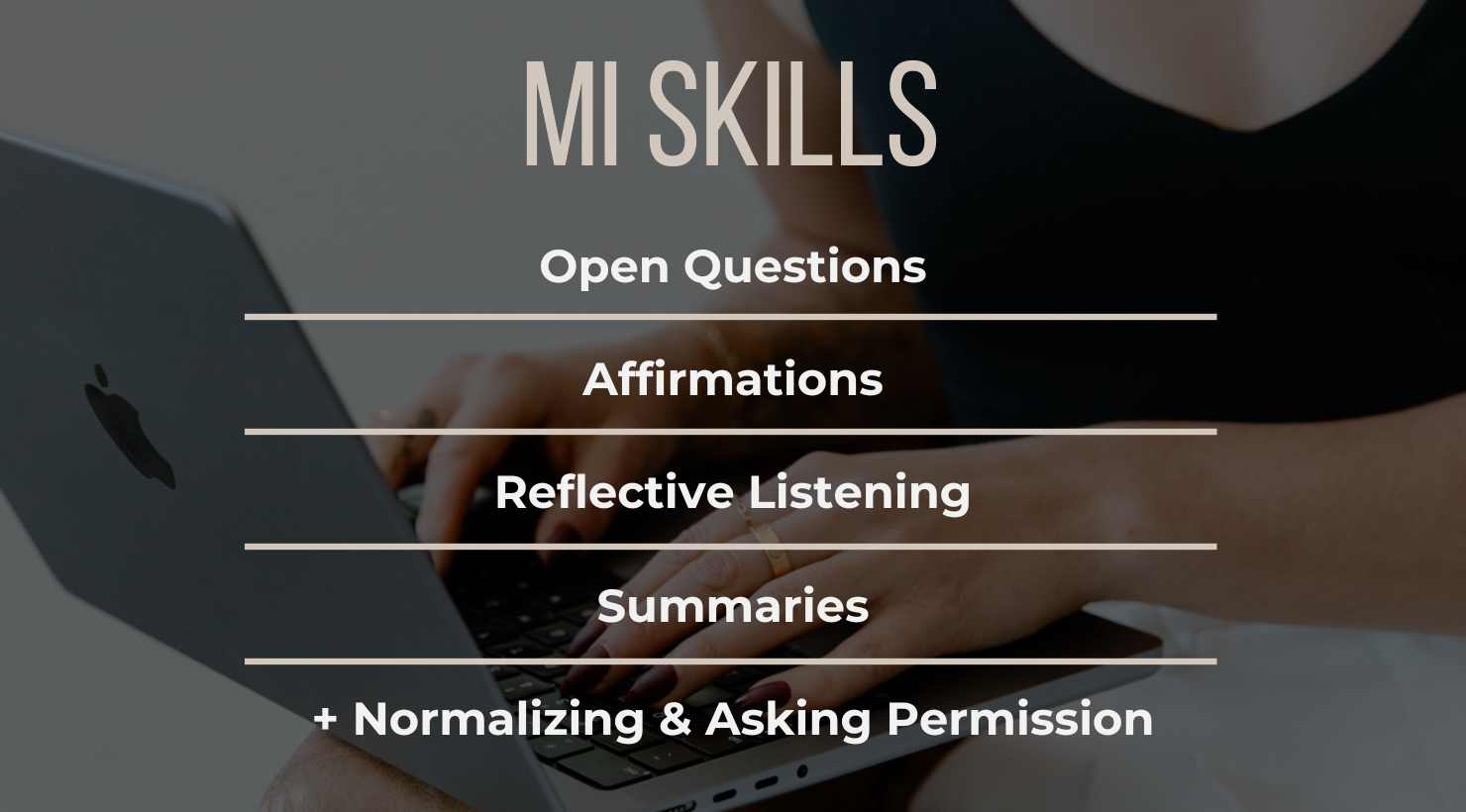
Motivational Interviewing Techniques
As I mentioned earlier, motivational interviewing is a skill that requires training and practice. You will most likely feel awkward at first, but you'll become confident doing it with the proper training and implementing what you learn.
The first step in motivational interviewing is to build a strong rapport with your clients. Establish a trusting relationship by showing genuine interest in their lives and goals. Use open questions to encourage them to share their experiences.
Open questions encourage clients to talk about their challenges, strengths, beliefs, and motivations beyond one word answers so your client does most of the talking.
Better Questions, Better Answers, Better Outcomes:Standard Coaching vs Motivational Interviewing |
|
Standard Coaching
|
Motivational Interviewing
|
|
|
Get Your Motivational Interviewing Cheat Sheet for Dietitians Here👇
I'm not saying you have to be their best friend because boundaries are important, but you do have to genuinely care about the people you're helping.
Once you've built rapport, you should help your clients set clear, specific, and achievable goals.
You might already use the SMART (Specific, Measurable, Achievable, Relevant, Time-bound) method, but I actually prefer the SMARTER goal framework because it’s more supportive for clients who struggle with a fixed mindset.
SMARTER GOALS ARE:
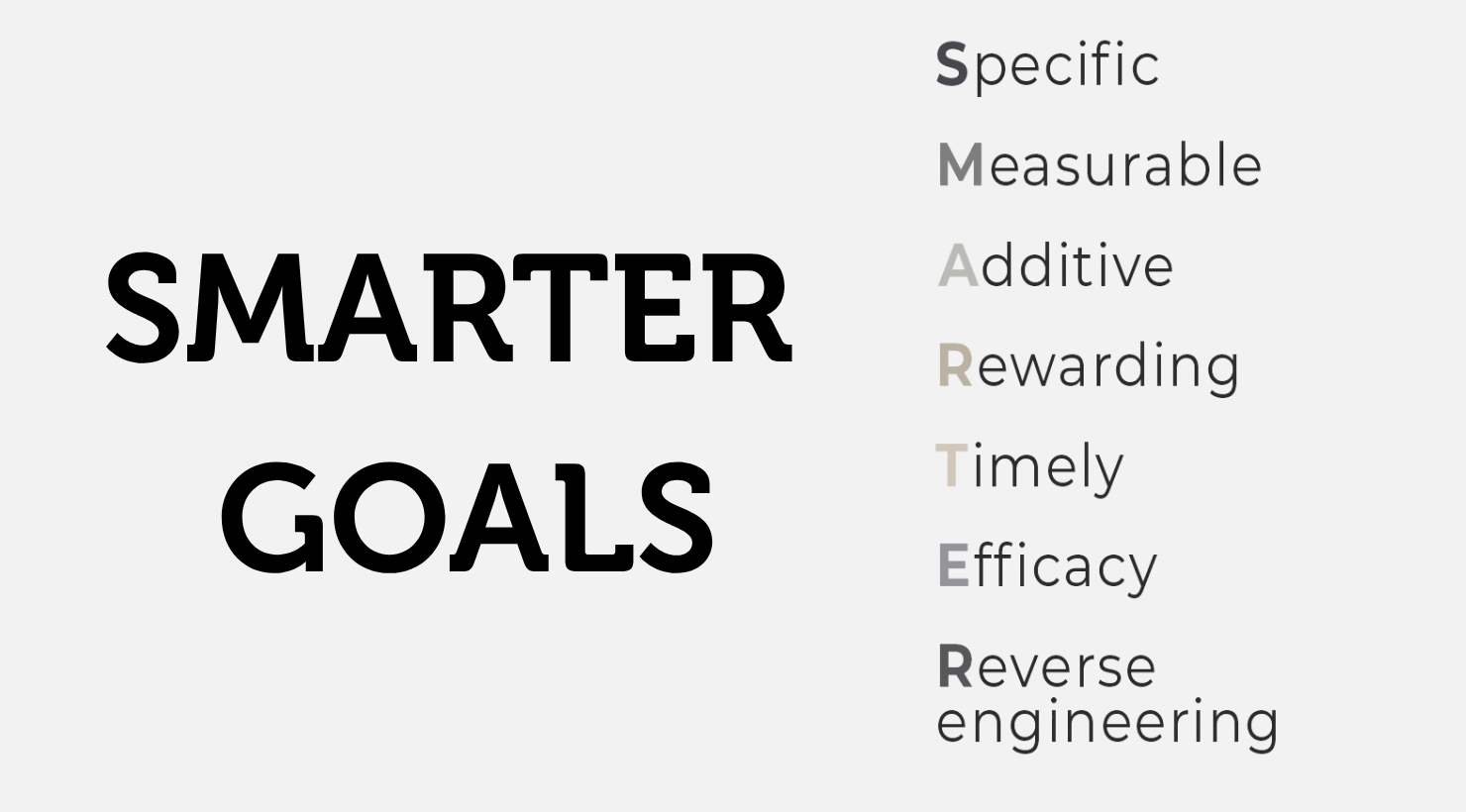
This is the Health Mindset Coaching Certification's updated goal-setting framework based on behavior change research and years of coaching experience.
We swap out a few concepts from the SMART framework and add a couple more. Because, ultimately, the biggest issue I have with SMART goals is that they don’t account for fixed mindset tendencies.
Once your clients have set SMARTER goals for themselves, you want to explore ambivalence.
Clients often feel ambivalent about change. Use reflective listening to understand their mixed feelings and explore the pros and cons of their current behavior versus their desired changes.
Key Coaching Terms: Reflective ListeningReflective listening is an essential motivational interviewing skill. In practice, reflective listening uses paraphrasing what your clients say to show you understand what they’re saying and encourage them to express more of their thoughts and feelings. Your ability to express empathy is very important here. It will help build further rapport with your clients, which builds greater trust, and contributes to a deeper sense of belonging–all of which help your clients be even more successful, even faster. (And makes you more money while making your job even more meaningful and fulfilling.) |
Next, highlight the discrepancy between your client's current behaviors and the broader goals they hired you to help them achieve. This reflection can help clients recognize the need for change.
Remember to support self-efficacy throughout the process. Encourage your clients to believe in their ability to change. Acknowledge their strengths and past successes to build their confidence.
Then, you'll want to summarize the discussions you've had to highlight the key points and ensure you understand what they’re trying to communicate, and what their priorities are. This is when you collaboratively develop a plan of action that your client feels confident about.
Regular follow-ups are crucial to maintaining motivation and making necessary adjustments to the plan. Make sure you're asking the right questions during your client check-ins to get a solid understanding of how your client is progressing and where they might be struggling.
These motivational interviewing techniques can create a supportive environment that enhances your client's motivation and leads to better adherence and sustainable behavior change.
Swipe these health mindset coaching strategies to help your clients unlock their potential and achieve their fitness goals.
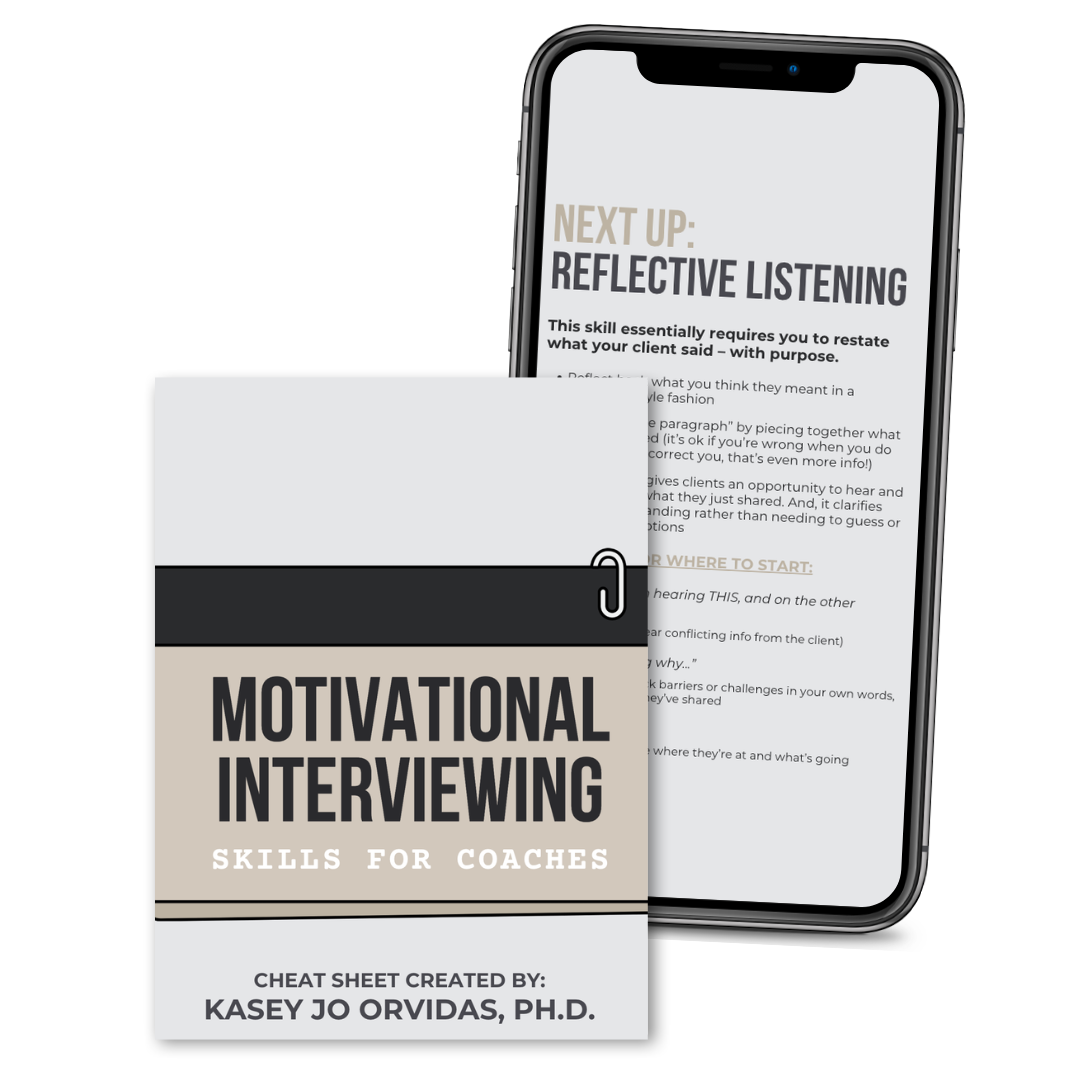
Health Coach Hack: Get Your Motivational Interviewing Cheat Sheet 👇
FREE COACHING GUIDE
How to Incorporate Motivational Interviewing in Your Coaching Practice
If you’ve been paying attention, I know you can already see how incorporating motivational interviewing in your coaching practice can help your clients achieve their goals faster. (And help you make more money.)
While I gave you some pointers above, it's important to remember that this method is more complex than I can teach in a single blog post.
If you truly want to make the most of motivational interviewing to help your clients improve their physical health conditions and potentially even improve their mental health, I strongly encourage you to sign up for the Health Mindset Coaching Certification.
The Health Mindset Coaching Certification is a program for health and fitness professionals that equips you with the skills needed to help your clients end self-sabotage, break through mindset barriers, and make behavior changes for good.
It will help you develop the skills to effectively help clients stick to the plan, stick with you, and achieve long-term success in their health and fitness goals.
Throughout this live program, you’ll learn how to leverage the science of mindset and health behavior change to better encourage a growth mindset in your clients to promote increased retention, connection, adherence, and success.
Best of all? Health Mindset Coaching Certification is recognized by the National Academy of Sports Medicine, the Athletics and Fitness Association of America, and the American Council on Exercise as an approved continuing education provider.
Join the HMCC waitlist now, and you'll immediately get access to five FREE lessons in mindset and behavior change so you can start implementing these methods in your coaching practice right away!
Research on Motivational Interviewing and Health and Fitness
There are several studies that show that motivational interviewing is effective for encouraging behavior change in a variety of health and fitness areas.
Here are some of my favorites:
Motivational interviewing to increase physical activity in long-term cancer survivors: a randomized controlled trial
Fifty-six inactive adult cancer survivors were randomly assigned to either a motivational interviewing intervention group or a control group. The motivational interviewing group received one in-person counseling session and two follow-up phone calls over six months.
Results showed that the motivational interviewing group significantly increased physical activity, especially those with high self-efficacy for exercise. However, there were no significant differences in aerobic fitness, health, or fatigue between the groups.
The article indicates motivational interviewing may be especially beneficial for those confident in their exercise abilities.
Pathway to health: cluster-randomized trial to increase fruit and vegetable consumption among smokers in public housing
This study investigated how effective an intervention was at increasing fruit and vegetable intake among smokers living in public housing. The trial involved 20 public housing developments, with 10 assigned to receive the fruit and vegetable intervention and 10 to a smoking cessation program.
The results showed that the group focused on increasing fruit and vegetable intake boosted their consumption significantly compared to the smoking cessation group.
Motivational interviewing and trying new recipes were listed as being particularly effective strategies in helping the participants increase their fruit and vegetable intake.
If you read my blog post on how to identify high-quality research studies, you'll appreciate this study as using the most robust research methodology and having high real-world application.
Want more on motivational interviewing? Listen to this episode of my podcast, Not Another Mindset Show where I share even more about the guiding principles of motivational interviewing and examples of how you can use this tool in your coaching practice.
REMEMBER: Get your free Motivational Interviewing Cheat Sheet for health and fitness coaches here!
Answered: Your Most Frequently Asked Questions About Motivational Interviewing
What is motivational interviewing in health and fitness coaching?
Motivational interviewing (MI) is a client-centered approach to communication that helps coaches guide clients to behavior change by exploring those ambivalent, mixed feelings and internal conflicts. Instead of expecting clients to “push through” or telling them what to do, MI uses the exploration process to help clients build intrinsic motivation (aka the best kind of motivation). In health and fitness coaching specifically, research suggests MI is especially effective for lifestyle changes that are difficult to sustain, including exercise adherence and nutrition habits.
Is motivational interviewing within the scope of practice for dietitians and health coaches?
Yes, motivational interviewing is within the scope of practice for dietitians and health coaches. MI is a communication skill set, not a therapeutic intervention. Health coaches, dietitians, and dietitians can and do use MI techniques to have more effective conversations about behavior change. MI is not therapy and does not require a clinical license to apply within a coaching context.
How long does it take to learn motivational interviewing?
Motivational interviewing is a skill that requires ongoing practice, not just a single lesson. Most practitioners develop foundational competency over several months of consistent and ongoing practice, ideally while receiving client feedback throughout the process. Research on MI training suggests that one-time workshops rarely produce lasting proficiency on their own. Practitioners tend to build competency over months of consistent practice, ideally with feedback or coaching along the way. Learning alongside peers or a mentor can also help, since it creates more opportunities for that feedback.
Dr. Kasey Jo Orvidas, PhD spent years researching, publishing, and coaching health behavior change and mindset science before founding the Health Mindset Coaching Certification, an accredited program for health and fitness professionals.